From the Hosts
Resources
Frameworks, tools, and practical resources for music educators who want to build programs with intention.
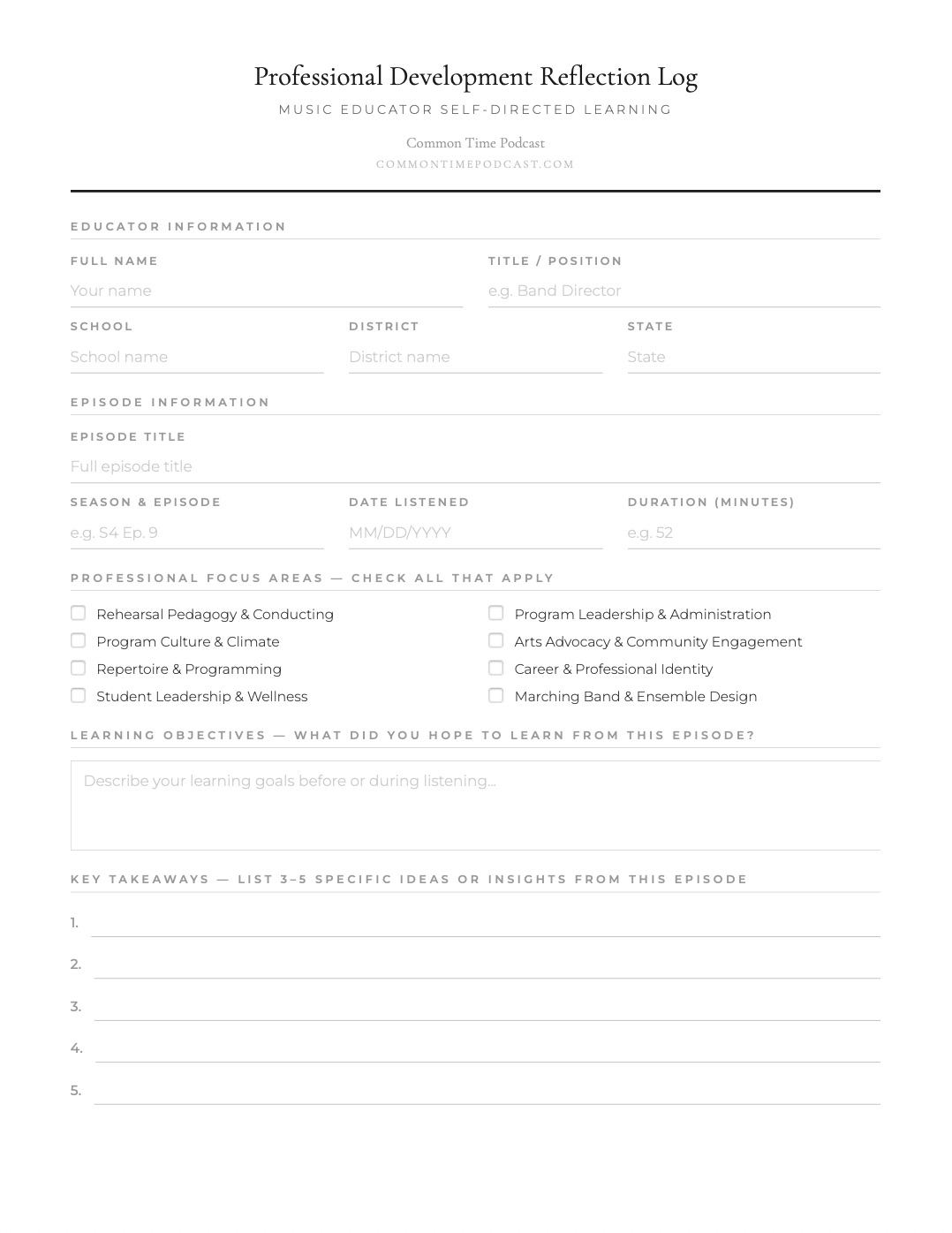
Count Your Listening as PD Credit
Every episode of Common Time is a genuine professional development experience — expert conversations on rehearsal pedagogy, program culture, leadership, repertoire, and more. Many states accept self-directed professional learning with written documentation and administrator approval.
Our PD Reflection Log is designed to meet that standard. Fill it out for any episode, submit it to your administrator, and count your listening toward your annual PD hours.
See state-by-state requirements →Step 1
Listen
Choose any episode of Common Time Podcast. Listen on Apple Podcasts, Spotify, YouTube, Amazon Music, or iHeart Radio.
Step 2
Reflect
Open the PD Reflection Log, complete the form — learning objectives, key takeaways, classroom application — and print or save as PDF.
Step 3
Submit
Submit the completed log to your administrator or include it in your professional growth portfolio. Check with your district for specific requirements.
Guest Suggested Reading
Books recommended by Common Time guests — leadership, pedagogy, mindset, and beyond.
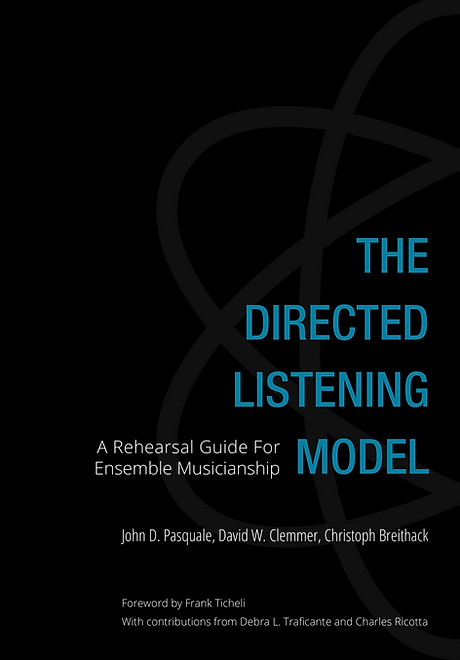
The Directed Listening Model
A rehearsal framework that transforms how ensembles listen, respond, and make music together — developing musicians who hear deeply and take ownership of the sound.
Pulse
Even flow of time, subdivision, and rhythm as the bedrock of ensemble cohesion.
Sound Production
Resonance, intonation, posture, and the physical foundations of a beautiful ensemble tone.
Comprehensive Balance
Ensemble symmetry and the balance equation — primary, secondary, and supportive color roles.
Musicality
Articulation, dynamics, phrasing, and the expressive language that turns notes into music.
“If you are looking for a book which explains, in detail, the various aspects to be considered while conducting and rehearsing — this is it. I am quite surprised that no one, until now, has taken the time to put into words all of the thoughtful analysis compiled in this volume — a genuine contribution.”
— H. Robert Reynolds
“Here is one of the more thought provoking books on ensemble music making to come along in recent years — one that will fascinate and enlighten conductors and performers who share a belief that rigorous objective attention to details is essential for anyone who hopes to achieve the aim of producing profoundly beautiful musical results.”
— Frank Ticheli
Bring the DLM to Your Program
Beyond the book, we offer professional development sessions and conference presentations built around the Directed Listening Model — designed for ensembles, departments, and state conferences. If you’re interested in bringing this framework to your school, district, or event, we’d love to connect.
MaestroMind™ Blueprint
An architectural framework for purpose-driven, student-centered ensemble leadership — designed to build measurable, sustainable program culture from the inside out.
Foundation
Purpose
The artistic north star. Vision mapping, student profiles, and the systems that give your program direction and predictability.
Walls
People
Belonging before risk. Psychological safety, student ownership, and the culture where great music becomes possible.
Roof
Process
The Directed Listening Model at the center. Rehearsal design, shared vocabulary, and measurable ensemble musicianship.
Atmosphere
Presence
Flow, growth mindset, and the capacity to sustain joy and quality in every moment of every rehearsal.
“People then Process.”
Without purpose and people firmly established, even the best pedagogical tools fall short of their potential. MaestroMind™ Blueprint builds the room where great music is possible — before it teaches you how to make it.
Common Time Collective
Our private Facebook community for music educators. Ongoing episode discussions, peer networking, curated resources, and direct engagement with hosts David and John. Free to join — always.
RecognitionNominate a Standing Ovation
Know a music educator doing extraordinary work? Nominate them — our ongoing recognition for educators making a real difference in their students’ lives and communities.
Listener SurveyShare Your Feedback
Help us make Common Time better. Our anonymous listener survey takes just a few minutes and directly shapes the topics, guests, and format of future episodes.