Framework
MaestroMind™ Blueprint
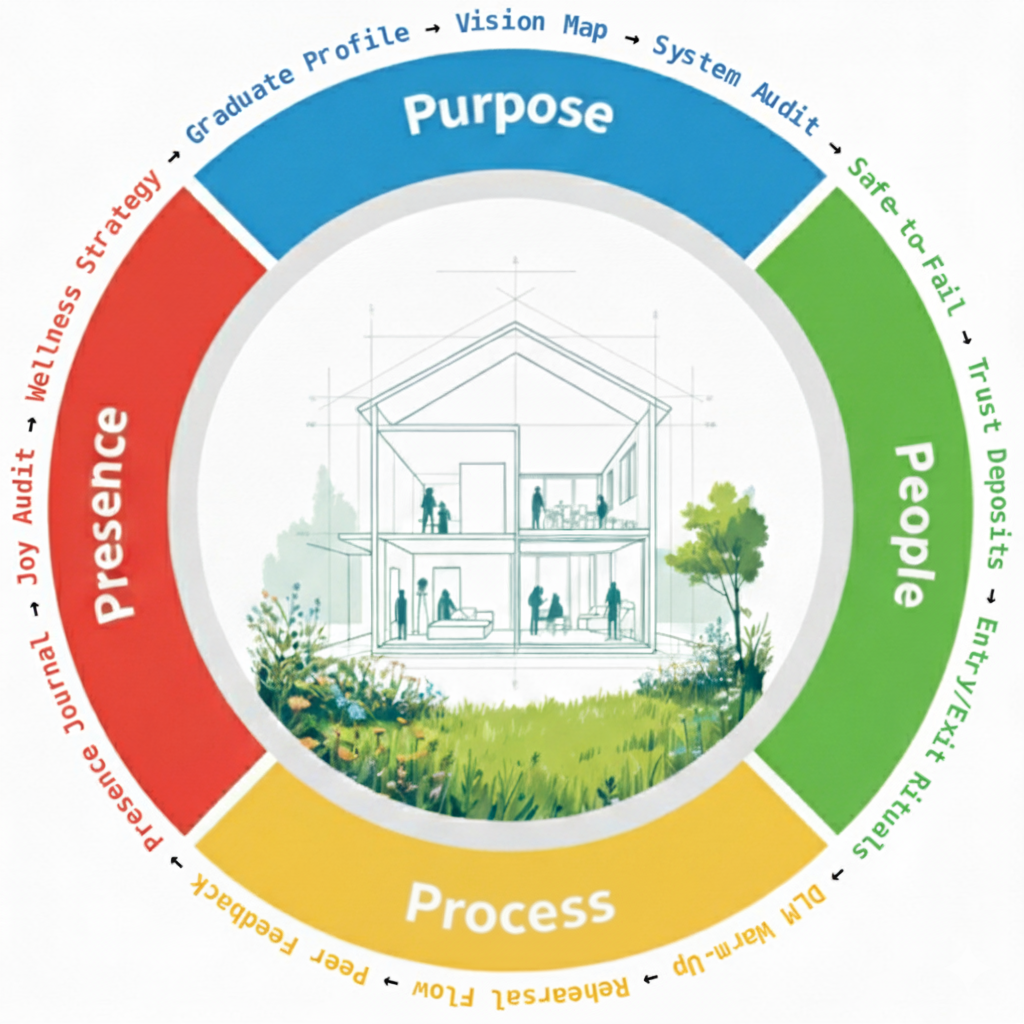
Building with Intention — an architectural framework for purpose-driven, student-centered ensemble leadership. Four pillars. One coherent system. A program that lasts.
The Metaphor
Every great ensemble is built like a house.
A house without a foundation collapses. Walls without a foundation lean. A roof without walls is just weather. And all of it — the structure, the shelter, the function — depends on the atmosphere inside. Whether anyone actually wants to live there depends on that.
MaestroMind™ Blueprint maps each element of that architecture onto the elements of a thriving ensemble program — and sequences them deliberately. You don’t start with the roof.
Foundation
Purpose
Why the program exists and where it’s going
Walls
People
The culture that holds everything up
Roof
Process
The rehearsal framework that shapes musicianship
Atmosphere
Presence
The quality of experience inside the program
“People then Process.”
The Foundation
Purpose
A program without a clear direction is just activity. Purpose is the foundation — the intentional design of where you are going, why it matters, and how every student fits into that vision. It answers the question before anyone has to ask it.
When purpose is visible, students don’t just follow the director — they follow the vision.
Artistic North Star
A clear, shared articulation of what the program is working toward — musically, culturally, and personally.
Vision Planning Map
A structured tool: Desired Outcome → Current Reality → Action Steps. Closes the gap between where you are and where you’re going.
Systems & Predictability
Routines and structures that create safety through consistency. When students know what to expect, they can take risks.
Giving an A
Rooted in Zander’s principle: assume capability, set high expectations, and watch students rise to meet them.
The question every director should be able to answer: Do your students know where they’re going — and do they believe they can get there?
The Walls
People
Before students can make extraordinary music, they need to feel extraordinary in the room. People is the pillar that makes the ensemble safe enough for risk, connected enough for vulnerability, and strong enough to fail forward.
The walls don’t just hold the structure up — they define what happens inside.
“I am safe here. I matter here. I contribute here.”
Belonging Before Risk — the foundation of the People pillar
Norms Culture
Shared agreements co-created with students: Curiosity over Perfection, Listen Louder Than You Play, Own the Reset, and more.
Safe-to-Fail Practices
Designing rehearsal moments where mistakes are expected and learning from them is the standard — never a “gotcha.”
Entry & Exit Rituals
Structured moments that open and close every rehearsal with intention: belonging check-ins, focus questions, student shout-outs.
Student Leadership
Leadership Labs that develop real skills: peer feedback, micro-decision-making, and the responsibility to contribute beyond playing.
The question every director should be able to answer: Does every student feel safe to contribute — and expected to lead?
The Roof
Process
Once purpose gives direction and people create the culture, the roof goes on: a rigorous, repeatable rehearsal process that makes growth measurable and musicianship intentional. Process is not a random sequence of run-throughs — it is a designed system for listening, diagnosing, and improving.
At the center of the Process pillar is the Directed Listening Model — a framework that gives directors a shared vocabulary and a diagnostic lens for every rehearsal decision.
The Directed Listening Model — Four Components
Pulse
Even flow of time and subdivision — the bedrock of ensemble cohesion.
Sound Production
Resonance, intonation, and the physical foundations of a beautiful tone.
Comprehensive Balance
Ensemble symmetry across primary, secondary, and supportive color roles.
Musicality
Articulation, dynamics, and phrasing — the expressive language of music.
The 5-D Listening Loop — the diagnostic engine behind every rehearsal decision.
Detect → Diagnose → Decide → Demonstrate → Discuss
Shared Vocabulary
Precision in language shapes precision in listening. When everyone uses the same words, diagnosis becomes faster and feedback becomes actionable.
Three Listening Levels
Individual → Section / Connected Trios → Full Ensemble. Students learn to expand their awareness one level at a time.
Rehearsal Design
Every rehearsal is built with intention — not just what to work on, but how to sequence it for maximum retention and musical ownership.
Measurable Growth
The DLM gives directors a consistent lens so improvement is observable, documentable, and not dependent on intuition alone.
The question every director should be able to answer: Does your rehearsal language create precision — or just correction?
The Atmosphere
Presence
You can have a solid foundation, strong walls, and a well-designed roof — and still walk into a room that feels joyless, exhausted, or simply going through the motions. Presence is what lives inside the structure. It’s the quality of attention, energy, and experience that determines whether students thrive or just survive.
Presence is defined as the capacity to sustain joy and quality in every moment. That sustainability is what makes a program last — for students and for the director.
Flow
Rooted in Csikszentmihalyi’s research: the conditions where challenge meets skill and deep engagement becomes possible.
Growth Mindset
Grounded in Dweck’s work: progress over perfection, effort as the path, and the belief that ability is built — not fixed.
Four Cornerstones
Predictability, Joy, Reflection, and Sustainability — the practical pillars of a Presence-driven program.
The Flow Cycle
Design → Experience → Reflect → Recalibrate. A repeating loop that keeps the ensemble — and the director — growing.
The question every director should be able to answer: Is your program sustainable — for your students and for you?
The Garden
The house is built for the people inside it. But a great program grows beyond its walls. The garden surrounding MaestroMind™ Blueprint is where students become leaders, musicians become citizens, and the work of the ensemble extends into something that outlasts any single concert or school year.
Small wins are the flowers. The mature trees are alumni who carry the culture forward. A program that builds its garden intentionally leaves a legacy — not just a record.
Get in Touch
Interested in MaestroMind™ Blueprint?
Whether you’re exploring the framework for your own program or interested in professional development opportunities, we’d love to connect.
Get in Touch